
Why am I always tired?
You sleep 7 or 8 hours and still wake up tired. Coffee carries you through the day. In the evening, you feel wired and tired at the same time.
If your sleep is sufficient and the obvious medical causes are ruled out, look at your stress response. In people with intense jobs, constant tiredness is often a stress response that has fallen out of rhythm.
Your stress response is an energy system
Cortisol is known as your body's stress hormone. Yet its main job is to provide energy. It raises your blood sugar, so your brain and muscles have fuel when you need it.
Cortisol follows a daily rhythm. It rises sharply in the first 30 to 45 minutes after waking (the cortisol awakening response) and gets you ready for the day. Then it falls slowly, so your body can wind down and repair at night.
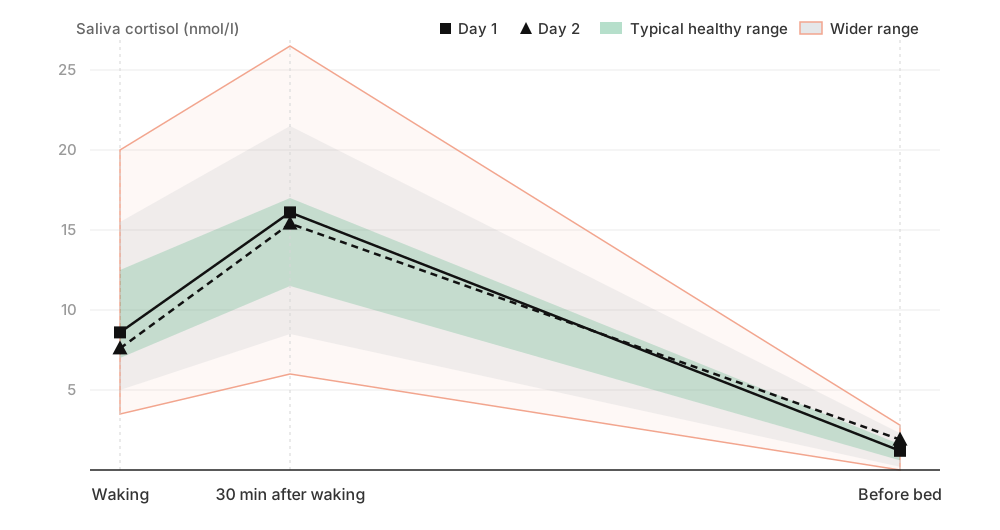
When this rhythm works, you feel awake in the morning and tired in the evening. When your body doesn't follow this rhythm, you often feel the opposite.
Two ways the stress response fails
Scientist Bruce McEwen spent his career studying the price your body pays for stress. In a landmark paper in the New England Journal of Medicine (1998), he described how the systems that protect us under stress start to cause damage when they are used too often or regulated badly. He called this wear and tear allostatic load.
In simple terms, the stress response can fail in two directions.
Overactivation. The system switches on too often or does not switch off. Cortisol stays high into the evening. Your heart keeps working at night. Sleep becomes light and does not restore you. Many people describe this as "wired but tired."
Underactivation. The system no longer responds enough. McEwen called this an inadequate response. When cortisol does not rise when it should, other systems compensate. Inflammation, which cortisol normally keeps in check, can run higher. You feel flat, slow and drained.
The two are often connected. Stress researchers at the University of Trier proposed that low cortisol may develop after a long period of overactivation from chronic stress. They describe a triad that comes with it: higher stress sensitivity, pain and fatigue.
The consequences of a failed stress response
The research points in one direction: the more aligned your daily cortisol rhythm, the better for your health. When the rhythm flattens or shifts, it shows up across your body.
A meta-analysis of 80 studies linked a flatter daily cortisol curve, with less difference between morning and evening, to worse health. The link was strongest for immune and inflammation outcomes.
A systematic review on fatigue found that the shape of the curve matters more than the total amount. The morning rise and the slope across the day were most relevant to how tired people felt.
In women with chronic fatigue syndrome, the morning cortisol rise was smaller than in healthy women, and hair cortisol tended to be lower.
Metabolic and mitochondrial problems are often a consequence of a failed stress response, not a separate issue. Take blood sugar. Cortisol signals your liver to release more sugar into the blood to keep your energy up. In the short term, that is exactly what you need. Over months, it becomes a problem. This is McEwen's core idea: what protects you in the short term can harm you in the long term.
Timing matters too. In a study from the University of Chicago, the same rise in cortisol barely changed blood sugar in the morning. In the evening, blood sugar rose much more and stayed high for at least 12 hours, along with more insulin. High evening cortisol can push your blood sugar regulation off balance.
Your mitochondria, the energy plants of your cells, are affected as well. A systematic review by Martin Picard and Bruce McEwen found that chronic stress changes how mitochondria work, in most studies for the worse. Most of this evidence still comes from animal studies.
First, rule out the basics
Constant tiredness has many possible causes. Before you look at stress, check the basics with your doctor: iron stores (ferritin), vitamin B12, thyroid function and the quality of your sleep. These are common, easy to test and easy to fix.
Iron is a good example. In a randomized trial with 198 women who had unexplained fatigue and low iron stores but no anemia, fatigue dropped by 48% with iron supplements, compared with 29% on placebo.
Once these are ruled out, the most effective lever is often the simplest one: bring your day back in line with your cortisol rhythm.
How to get your energy back
Your body runs on a 24-hour clock. Light, food, movement and sleep timing are the four signals that set it, as a 2025 scientific statement from the American Heart Association describes. The goal is simple: high energy and activity in the morning, a clear wind-down in the evening. These are the habits we start with most often.
Get outdoor light in the morning. Spend 5 to 10 minutes outside within the first one to two hours after waking. If it is still dark, use a daylight lamp. In a study at the University of Chicago, bright morning light raised cortisol by more than 50% right away and helped people stay alert. The same light in the afternoon had no such effect.
Move early and put hard work first. Train before lunch where you can. Block 60 to 90 minutes before 11 a.m. for your most demanding task, and keep lighter work like one-on-ones or creative tasks for later in the day. Evening exercise is fine for most people. But a meta-analysis of 23 studies found that vigorous training that ends an hour or less before bed can make it harder to fall asleep.
Eat with daylight. Eat at consistent times, mostly between 8 a.m. and 6 p.m. Stop caffeine after lunch: in a sleep study, a strong dose of caffeine taken 6 hours before bed still cut sleep by more than an hour. Leave at least 3 hours between dinner and bedtime.
Build a wind-down routine. Follow the same calm routine every evening: a warm shower, gentle stretching, a few minutes of slow breathing or writing down open tasks. Dim the lights and put your phone away about 30 minutes before bed. In a Harvard study, normal room light before bedtime delayed the sleep hormone melatonin in 99% of people and cut its night-time release by about 90 minutes.
Keep a stable sleep window. Go to bed and get up within the same 30-minute window, weekends included. In a study of more than 60,000 people, regular sleep timing predicted mortality risk better than sleep duration did. On long flights, time your light exposure to the new time zone to adapt faster.
Most of these habits take under 10 minutes. Start with one or two, not all at once. After about a month, measure your cortisol rhythm again to see what changed.
How we measure stress at Sapiens
Feeling tired tells you something is off. It does not tell you why. At Sapiens, we measure your stress response directly. Saliva cortisol, sampled at home over two days, shows your daily rhythm. Hair cortisol shows the long-term picture of the last three months. Together with heart rate monitoring for recovery, they show whether your stress response runs too high, too low or out of rhythm.
Our allostatic load model is built with Prof. Robert-Paul Juster (University of Montreal), who has published with McEwen on the biomarkers of chronic stress, and Prof. Clemens Kirschbaum (TU Dresden), who helped develop hair cortisol analysis. Our medical doctors, including Dr. med. Dominique S. Peschke, work as health coaches. They read your data, build your plan with you and check your progress with follow-up tests. We start with 1 to 3 small actions at a time, and 85% of our clients sustain their habit changes long-term. Sapiens is a wellness service and does not replace a medical diagnosis.
Being always tired is not a personality trait. It is a signal. Measure it, and you know which lever to pull.
Try the Sapiens diagnostics. Order the saliva cortisol test and see your own daily rhythm. Individual tests start at 159 EUR, and you can add hair cortisol, a blood test or other tests to the same order. Order your cortisol test
Not sure where to start? Take the allostatic load self-assessment or book a discovery call.
References
1. McEwen BS. Protective and damaging effects of stress mediators. N Engl J Med. 1998;338(3):171-179. doi.org/10.1056/NEJM199801153380307
2. Fries E, Hesse J, Hellhammer J, Hellhammer DH. A new view on hypocortisolism. Psychoneuroendocrinology. 2005;30(10):1010-1016. doi.org/10.1016/j.psyneuen.2005.04.006
3. Adam EK, et al. Diurnal cortisol slopes and mental and physical health outcomes: a systematic review and meta-analysis. Psychoneuroendocrinology. 2017;83:25-41. doi.org/10.1016/j.psyneuen.2017.05.018
4. Powell DJH, Liossi C, Moss-Morris R, Schlotz W. Unstimulated cortisol secretory activity in everyday life and its relationship with fatigue and chronic fatigue syndrome: a systematic review and subset meta-analysis. Psychoneuroendocrinology. 2013;38(11):2405-2422. doi.org/10.1016/j.psyneuen.2013.07.004
5. Roerink ME, et al. Hair and salivary cortisol in a cohort of women with chronic fatigue syndrome. Horm Behav. 2018;103:1-6. doi.org/10.1016/j.yhbeh.2018.05.016
6. Plat L, et al. Metabolic effects of short-term elevations of plasma cortisol are more pronounced in the evening than in the morning. J Clin Endocrinol Metab. 1999;84(9):3082-3092. doi.org/10.1210/jcem.84.9.5978
7. Picard M, McEwen BS. Psychological stress and mitochondria: a systematic review. Psychosom Med. 2018;80(2):141-153. doi.org/10.1097/PSY.0000000000000545
8. Vaucher P, Druais PL, Waldvogel S, Favrat B. Effect of iron supplementation on fatigue in nonanemic menstruating women with low ferritin: a randomized controlled trial. CMAJ. 2012;184(11):1247-1254. doi.org/10.1503/cmaj.110950
9. Knutson KL, et al. Role of circadian health in cardiometabolic health and disease risk: a scientific statement from the American Heart Association. Circulation. 2025;152(21):e408-e419. doi.org/10.1161/CIR.0000000000001388
10. Leproult R, et al. Transition from dim to bright light in the morning induces an immediate elevation of cortisol levels. J Clin Endocrinol Metab. 2001;86(1):151-157. doi.org/10.1210/jcem.86.1.7102
11. Stutz J, Eiholzer R, Spengler CM. Effects of evening exercise on sleep in healthy participants: a systematic review and meta-analysis. Sports Med. 2019;49(2):269-287. doi.org/10.1007/s40279-018-1015-0
12. Drake C, Roehrs T, Shambroom J, Roth T. Caffeine effects on sleep taken 0, 3, or 6 hours before going to bed. J Clin Sleep Med. 2013;9(11):1195-1200. doi.org/10.5664/jcsm.3170
13. Gooley JJ, et al. Exposure to room light before bedtime suppresses melatonin onset and shortens melatonin duration in humans. J Clin Endocrinol Metab. 2011;96(3):E463-E472. doi.org/10.1210/jc.2010-2098
14. Windred DP, et al. Sleep regularity is a stronger predictor of mortality risk than sleep duration: a prospective cohort study. Sleep. 2024;47(1):zsad253. doi.org/10.1093/sleep/zsad253
15. Juster RP, McEwen BS, Lupien SJ. Allostatic load biomarkers of chronic stress and impact on health and cognition. Neurosci Biobehav Rev. 2010;35(1):2-16. doi.org/10.1016/j.neubiorev.2009.10.002


